
For more than a year, the single hardest question in SEO has been a maddeningly simple one: are we showing up in Google's AI answers, or not? AI Overviews and AI Mode have been quietly rerouting a chunk of every search journey, and the honest answer from inside Search Console was a shrug. That is finally starting to change. As of 23 June 2026, Google is rolling its new AI performance report out to far more sites, after a limited launch earlier in the month. If you have not seen it yet, you likely will soon.
Google's John Mueller framed the cadence plainly on Bluesky: "We're just rolling these out incrementally to sites, and reviewing the feedback along the way." Barry Schwartz at Search Engine Land flagged the wider rollout after a wave of SEOs across the US, UK, India and Switzerland posted that access had landed for them that morning. So this is not a redesign of Search Console; it is a long-requested window finally opening for a much bigger audience.
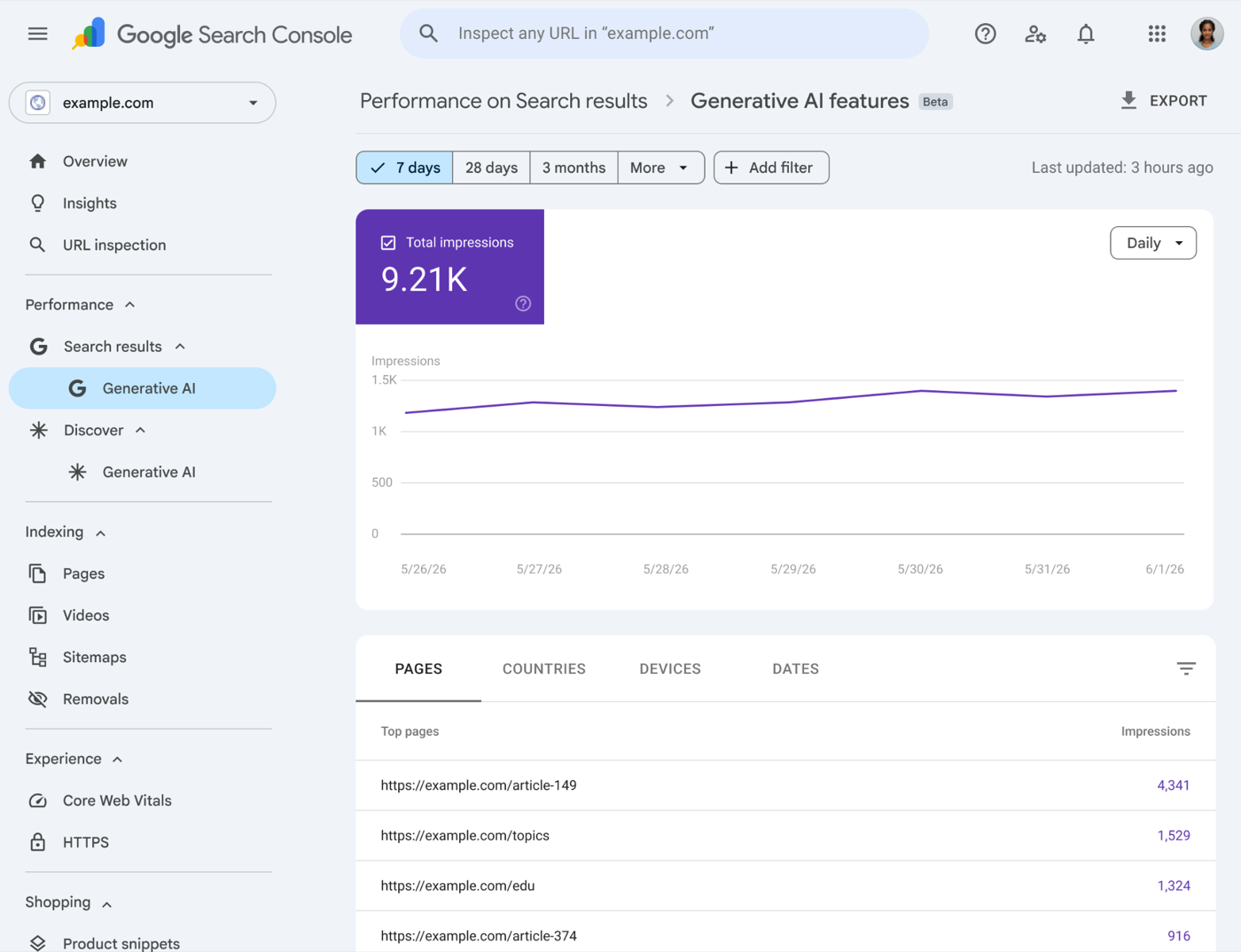
What the report actually shows
The new view reports how your content surfaces inside Google's generative answers, both AI Overviews and the more conversational AI Mode. You get the dimensions Search Console regulars already know: impressions, the pages being surfaced, plus breakdowns by country, device and date. In other words, you can finally see that you are appearing in AI answers, on which queries, and roughly how that is trending over time.
That sounds modest. It is not. Until now, AI Overview impressions were folded into your general Search performance with no way to separate them out, so "are we in the AI answer" was a question you answered by manually searching and screenshotting. A dedicated report turns that guesswork into something you can baseline and watch.
The one number it leaves out
Here is the catch worth being clear-eyed about: there is no click data. The report shows impressions but not the clicks those AI appearances send you. That is a meaningful gap, because the whole anxiety about AI Overviews is that they answer the question on the results page and the user never clicks through. A report that shows impressions without clicks tells you that you were cited, but not whether that citation earned you a single visit.
Impressions without clicks answers "were we in the answer." It does not answer "did being in the answer do anything for us." Read the report knowing which half you are looking at.
So treat the new data as a visibility signal, not a traffic one. It is genuinely useful for confirming presence and spotting where you have vanished. It is not, on its own, proof of value, and anyone presenting AI-impression growth as a revenue story is skipping the part Google has not yet handed over.
Why Google is shipping this now
Publishers have been asking for exactly this since AI Overviews launched, alongside louder requests for controls over how their content is used. The performance report is the measurement half of that ask arriving first. It does not give you a lever to opt content in or out of AI answers, but it does give you the instrumentation to argue about it from data rather than vibes. Given how incrementally Google is rolling it out, expect the metrics on offer to evolve, and watch closely for whether click data ever joins the party.
How to read it, this week
- Baseline immediately. The value of this report compounds over time. Check it the day it appears for you and note where your impressions sit, so the trend line means something in three months.
- Find the pages that show up. Cross-reference the AI-surfaced pages against your money pages. If your AI presence clusters on top-of-funnel explainers and disappears on commercial queries, that is a content gap with a clear address.
- Pair it with click reality. Because the report omits clicks, sit it next to your normal Search performance and your analytics. If AI impressions are climbing while sessions to those pages flatten, you are seeing the zero-click effect in your own numbers.
- Do not over-react to a single reading. One snapshot of a brand-new, still-rolling-out report is noise. The signal is the trend, and the trend needs time.
Where we come in
Our AI Visibility Audit reads exactly these signals for you and joins them to the clicks Search Console will not show: which queries trigger an AI answer in your market, whether you are cited, what share of that answer space you own versus competitors, and where the impression-rich, click-poor pages are quietly leaking opportunity. The new report is a welcome window. We tell you what to do about the view through it, in a prioritised order your team can action.